







Hammer Curls: The Complete Guide to Bigger Arms, Stronger Forearms, Better Grip
If your goal is to build stronger, thicker, and more complete-looking arms, Hammer Curls deserve a place in your training routine. This simple dumbbell exercise uses a neutral hand position that feels natural for many lifters while giving the biceps, brachialis, brachioradialis, and forearm muscles meaningful work. It can be performed by beginners, experienced gym-goers, athletes, and anyone who wants to improve practical upper-arm strength without complicated equipment.
What makes this movement especially useful is its versatility. You can perform it standing, seated, alternating, simultaneously, or with different forms of resistance. The exercise is easy to learn, but getting the most from it requires more than simply moving a dumbbell from your hip toward your shoulder. Your elbow position, wrist alignment, range of motion, tempo, posture, and choice of weight can all influence how effectively the target muscles work.
This guide explains everything you need to know, from proper technique and muscle activation to programming, common mistakes, variations, progression strategies, and frequently asked questions. Whether you are completely new to resistance training or trying to improve your arm workouts, the goal is to help you understand not just what to do, but why it works.
What Are Hammer Curls?
Hammer Curls are a dumbbell-based elbow-flexion exercise performed with the palms facing inward toward each other. Unlike the traditional dumbbell curl, where the palms commonly rotate upward as the weight rises, the neutral grip remains relatively unchanged throughout the movement. This gives the exercise its familiar “hammer” appearance and name.
The neutral grip changes the emphasis across the muscles of the upper arm and forearm. The biceps still contribute significantly, but the brachialis and brachioradialis can become especially important. The result is an exercise that fits naturally into programs focused on arm hypertrophy, general strength, grip development, and athletic performance.
Another advantage is simplicity. You do not need a cable machine, specialized attachment, or complicated setup. A pair of dumbbells and enough space to move safely are generally sufficient. Because the movement is straightforward, it can also be adjusted easily for different experience levels.
“Good technique does not make an exercise easier; it makes the effort more productive.”
For many people, the biggest mistake is treating a simple movement as if technique does not matter. A controlled curl with an appropriate load can provide much more useful training stimulus than a heavier repetition performed with excessive momentum.
Why This Exercise Deserves a Place in Your Arm Workout

An effective arm routine does not have to contain dozens of exercises. What matters more is whether the selected movements train the muscles effectively and whether you can progressively increase the training stimulus over time. This exercise works well because it complements conventional curls while offering a slightly different grip and loading experience.
The neutral wrist position can also feel comfortable for people who find fully supinated curls awkward. That does not mean it is automatically better for everyone. Different exercises suit different bodies, goals, and preferences, but the neutral-grip curl is versatile enough to remain useful across many training styles.
It can also fit into different parts of a workout. Some lifters place it early when strength is the priority, while others use it later as an accessory movement after compound pulling exercises. Because dumbbells allow each arm to work independently, the exercise can also reveal strength differences between sides.
For hypertrophy-focused training, the key is not simply feeling a huge pump. The muscles need sufficient mechanical tension and challenging sets performed with good technique. Consistency, recovery, nutrition, and progressive overload ultimately determine whether those training sessions turn into measurable growth.
Muscles Worked During the Movement
Several muscles contribute when you curl a dumbbell using a neutral grip. Understanding their roles makes it easier to appreciate why this movement can produce a different sensation from a traditional curl.
The biceps brachii is one of the major elbow flexors and remains involved throughout the exercise. It also contributes to forearm supination, although the neutral grip means you are not deliberately rotating the palm upward during each repetition. Because of that, the exercise does not place exactly the same demands on the biceps as a fully supinated curl.
The brachialis is particularly interesting. It sits underneath the biceps and acts primarily as an elbow flexor. Developing this muscle can contribute to a thicker appearance around the upper arm because it adds mass beneath and alongside the biceps.
The brachioradialis, a prominent forearm muscle, also plays an important role. It assists with elbow flexion and is heavily involved when the forearm is held in a neutral position. This is one reason people often feel neutral-grip curls strongly through the upper forearm.
The forearm muscles also help stabilize the wrist and maintain a secure grip. Although this is not a dedicated grip-strength exercise, repeated controlled work can contribute to better strength and endurance in the hands and forearms.
The shoulders and upper back also have a supporting role. They should not be the primary drivers of the repetition, but they help maintain the position of the upper arm and torso. Good technique keeps this assistance controlled rather than allowing the body to swing the weight upward.
How to Perform Hammer Curls Correctly

Start by standing upright with a dumbbell in each hand. Let your arms hang naturally beside your body, keep your palms facing inward, and position your feet approximately hip- to shoulder-width apart. Your chest can remain comfortably lifted while your shoulders stay relaxed rather than pulled excessively backward.
Brace your midsection gently before starting the first repetition. This creates a stable base and makes it easier to keep your torso from moving unnecessarily. Your elbows should remain close to your sides without being forcibly pinned against your body.
From the starting position, bend your elbows and raise the dumbbells toward your shoulders. Keep the palms facing inward and avoid intentionally rotating the wrists. Move the weights smoothly rather than trying to accelerate them with your hips or lower back.
As the dumbbells approach the upper portion of the movement, squeeze the working muscles briefly without aggressively forcing the elbows forward. The exact finishing position will vary slightly depending on anatomy and range of motion, but you should remain comfortable and controlled.
Lower the dumbbells slowly back toward the starting position. Do not simply drop them. The lowering phase is part of the repetition and gives you another opportunity to create useful muscular tension.
“The dumbbell should move because the elbow is flexing, not because the torso is swinging.”
Once both arms return to a controlled starting position, repeat for the desired number of repetitions. Breathing should remain natural. Many lifters find it comfortable to exhale during the lifting phase and inhale while lowering, although maintaining steady breathing is more important than following a rigid breathing pattern.
The Importance of a Neutral Grip
The neutral grip is the defining feature of this exercise. Instead of pointing your palms toward the ceiling, you keep them facing each other. This small adjustment changes the position of the forearm and affects how different elbow flexors contribute.
A neutral position can also feel more natural at the wrist. When the hands are neither fully pronated nor deliberately supinated, some people experience less discomfort during curling movements. Comfort matters because an exercise you can perform consistently is generally more useful than one that looks perfect on paper but irritates your joints.
The grip should be firm without becoming excessively tense. Squeezing the dumbbell can help you maintain control, but you do not need to crush the handle. Keep the wrist relatively straight rather than allowing it to bend backward as the weight becomes difficult.
The neutral position is also why this exercise is often included in routines designed to develop the forearms. The brachioradialis is positioned to contribute effectively when the forearm is in this orientation.
How Much Weight Should You Use?
Choosing the right weight is one of the most important decisions you can make. A weight that is too light may not provide enough challenge, while a weight that is too heavy can turn a controlled curl into a full-body movement.
A practical starting point is to choose a load that allows you to complete your target repetitions with consistent technique while still feeling challenged near the end of the set. For many general fitness goals, moderate repetitions work very well. The exact number is less important than the quality of the set and your ability to progress over time.
If you cannot control the lowering phase, the weight is probably too heavy. If your shoulders are repeatedly moving forward, your back is leaning, or your hips are generating momentum, reduce the load. A lighter dumbbell that keeps the target muscles working is usually the smarter choice.
As you become stronger, increase the load gradually. You can also progress by adding repetitions, improving control, increasing range of motion, or reducing unnecessary rest when appropriate. Progressive overload does not require constantly adding heavier dumbbells.
Repetition Range and Training Volume
There is no single magical repetition range for muscle growth. A broad range of repetitions can be effective when sets are sufficiently challenging and performed with appropriate technique. For an isolation-style exercise such as this one, moderate repetitions are often practical because they allow you to balance muscular tension, control, and fatigue.
Beginners can start conservatively while learning the movement. More experienced lifters may use different repetition ranges across training blocks. Heavier sets can emphasize strength, while moderately lighter sets can provide additional volume without requiring maximal loads.
Training volume should also be considered across the entire workout. Your arms may already receive substantial work from rows, pull-ups, pulldowns, presses, and other exercises. Adding endless curling sets is not automatically better.
A useful program gives the muscles enough stimulus to adapt while leaving enough recovery capacity for the next session. If your performance consistently declines, your elbows become irritated, or your arms remain excessively fatigued, it may be a sign that your total workload needs adjustment.
Hammer Curls for Muscle Growth
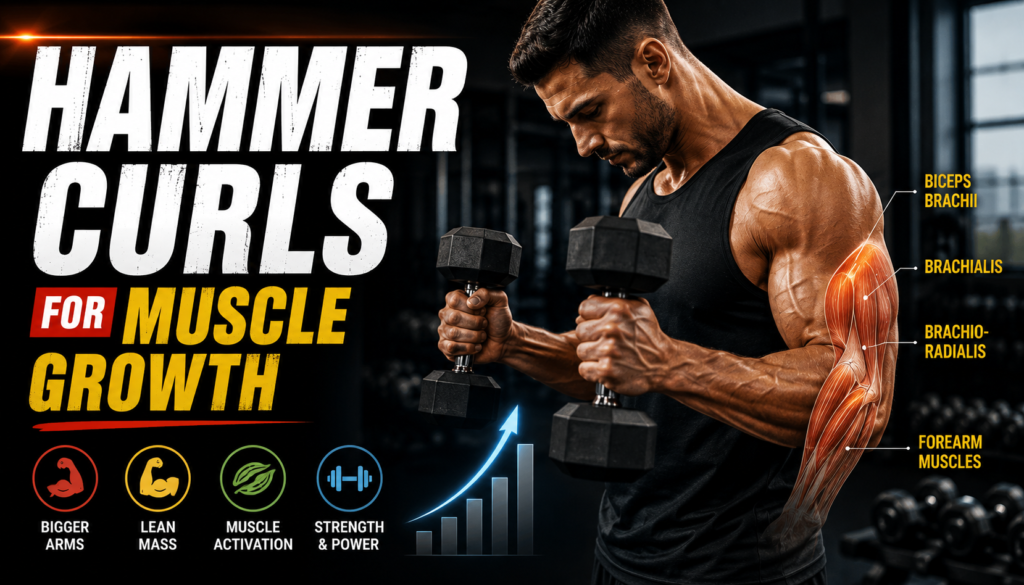
Building bigger arms requires more than chasing a temporary pump. Muscle growth occurs as your body adapts to repeated resistance training, provided that the overall training and recovery environment supports adaptation.
This exercise can contribute to arm hypertrophy by challenging the elbow flexors through a controlled range of motion. The brachialis and brachioradialis are particularly relevant, making the movement a useful complement to exercises that emphasize the biceps more directly.
For hypertrophy, focus on stable technique and sets that become genuinely challenging without sacrificing control. You should not need to swing dramatically to complete your final repetitions. If you consistently need momentum, the load or target repetition range may be inappropriate.
Nutrition also matters. Adequate protein, sufficient calories when gaining size, quality sleep, and consistent training all contribute to results. No curl variation can compensate for poor recovery or an inconsistent program.
Hammer Curls for Strength
Strength development is another reason to include this movement. Strong elbow flexors and forearms can support many pulling and carrying activities, from rows and pull-ups to loaded carries and everyday lifting.
When strength is the main objective, heavier loads can be used with lower repetitions, provided that you can maintain safe and controlled technique. However, an isolation movement usually does not need to be treated like a one-repetition-max exercise.
Instead, aim to become progressively stronger while keeping the movement clean. If you can perform the same weight for more quality repetitions than before, that is progress. If you can use a slightly heavier dumbbell without losing control, that is also progress.
Strength is highly specific, so this exercise should complement rather than replace larger compound movements when your goal is total upper-body strength.
Common Mistakes That Reduce Effectiveness
One of the most common errors is using too much weight. Heavy dumbbells may look impressive, but if you need to swing your torso to move them, the target muscles are no longer doing the majority of the work.
Another common mistake is allowing the elbows to travel excessively forward. Some movement can occur naturally, but repeatedly turning the curl into a shoulder-driven motion changes the exercise. Keeping the upper arms relatively stable makes the elbow flexors work more directly.
Rushing the lowering phase is another missed opportunity. Many people focus entirely on lifting the weight and then allow gravity to take over. A controlled descent improves overall movement quality and keeps the muscles under tension for longer.
Wrist movement can also become a problem. If the wrists repeatedly bend backward or collapse under the load, the exercise may become uncomfortable. Keep the hands stable and select a weight that allows you to maintain alignment.
Finally, avoid turning every set into a test of endurance. Once your technique breaks down significantly, continuing to force repetitions may provide less benefit and more unnecessary fatigue.
Standing Versus Seated Variations
Standing neutral-grip curls are the classic choice because they are convenient and allow a natural movement pattern. They also require you to stabilize your body while performing the exercise. For most people, standing is an excellent starting point.
The seated version can reduce opportunities to use the legs or hips for momentum. Sitting upright on a bench gives you a stable base and may make it easier to focus on the movement of the arms.
Neither version is universally superior. If standing curls cause you to swing heavily, try sitting down. If seated curls feel restrictive or uncomfortable, the standing version may be more suitable.
You can also alternate between them across different training phases. Variation can help maintain interest and provide slightly different training experiences without constantly changing the fundamental movement pattern.
Alternating and Simultaneous Repetitions
With alternating repetitions, one arm curls while the other remains in the starting position. This can make it easier to concentrate on one side at a time and may help identify differences in strength or coordination.
The simultaneous version has both dumbbells moving together. It is efficient and straightforward, but fatigue can sometimes encourage lifters to use momentum earlier because both arms are working at once.
Alternating repetitions can be particularly useful when one side tends to dominate. By giving each arm its own repetition, you can pay closer attention to the movement and avoid unconsciously allowing the stronger side to take over.
Both approaches can work. The better choice is the one that allows you to maintain consistent technique and progress within your program.
Cross-Body Hammer Curls
Cross-body curls involve bringing a dumbbell upward toward the opposite side of the upper chest or shoulder rather than directly toward the same-side shoulder. This changes the movement path and can provide a different sensation through the arm and forearm.
The cross-body variation can be useful when you want another way to train the elbow flexors without abandoning the neutral grip. Because the path is slightly different, it may also feel more comfortable for certain lifters.
Control remains important. Do not twist the torso aggressively to help the weight travel across the body. The arm should perform the majority of the work while the trunk remains stable.
As with other variations, use a manageable load first. A new movement path can feel more difficult even when the dumbbell is lighter than what you normally use.
Incline Dumbbell Curl Versus Neutral-Grip Curl
Incline curls and neutral-grip curls are often compared because both can be useful for arm development, but they emphasize different characteristics.
An incline curl generally places the upper arm farther behind the torso and commonly uses a supinated grip. This can create a strong stretch and emphasize the biceps in a different shoulder position.
The neutral-grip curl keeps the palms facing inward and tends to involve the brachialis and brachioradialis prominently. It can therefore complement an incline curl rather than compete with it.
A well-designed arm workout may use both. Instead of asking which exercise is “best,” consider what you need from your program. If your routine lacks neutral-grip elbow flexion and forearm involvement, this movement may fill that gap.
Hammer Curls Versus Traditional Dumbbell Curls

Traditional dumbbell curls are commonly performed with the palms facing forward or rotating toward a supinated position. This places substantial emphasis on the biceps and involves the muscles responsible for forearm supination.
The neutral-grip version keeps the palms facing inward. The brachialis and brachioradialis become particularly important contributors, while the biceps still participate.
This does not mean one exercise cancels out the other. In fact, combining different curl variations can be an effective way to train the elbow flexors through different positions and loading patterns.
If your main goal is comprehensive arm development, there is little reason to limit yourself to a single curl variation forever. Use exercises that complement each other and fit your body.
How to Program This Exercise
For a general arm-building routine, this movement can be placed after larger pulling exercises. Rows, pull-ups, and pulldowns require significant upper-body effort, so performing isolation work afterward can make the session more efficient.
You can also place it in a dedicated arm session. In that situation, combine it with exercises that provide different resistance profiles and grip positions.
A simple program might include a heavier curl variation followed by moderate-repetition neutral-grip work. The exact structure should depend on your training age, recovery ability, and total weekly volume.
“Progressive overload is not a race to the heaviest dumbbell in the gym.”
Instead, track your performance. Record the weight, repetitions, sets, and technique. Over several weeks, look for gradual improvement. That approach is more reliable than changing exercises constantly because you feel that a workout was not difficult enough.
A Practical Arm Workout Structure
A balanced arm session can begin with a compound pulling movement that trains multiple upper-body muscles. After that, you can move into a biceps-focused exercise and then use a neutral-grip curl to provide additional work for the elbow flexors and forearms.
Triceps should not be ignored if your goal is larger arms. The triceps make up a substantial portion of upper-arm mass, so a complete arm program should train both sides of the elbow.
Forearm work can be added when needed, but remember that gripping dumbbells, performing rows, carrying weights, and curling already provide some forearm stimulus.
The best routine is one you can recover from. If an arm workout leaves you unable to train your pulling movements properly for several days, the total volume may be higher than necessary.
Progression Strategies That Actually Work
The simplest progression method is to increase repetitions within a target range. Once you can perform the upper end with good technique, increase the weight slightly and build the repetitions again.
Another approach is to add a set. This increases training volume without immediately requiring a heavier dumbbell. However, additional sets should be introduced carefully because more volume also creates more fatigue.
You can also improve tempo. Slowing the lowering phase can make a familiar weight considerably more challenging. This is useful when equipment options are limited.
Range of motion is another progression tool. If your initial repetitions are short because you are learning the exercise, gradually developing a comfortable, controlled range can improve the quality of the movement.
The Role of Tempo and Control
Tempo determines how quickly you perform each portion of the repetition. While you do not need to count every second obsessively, controlling the movement is valuable.
The lifting phase should be deliberate rather than explosive and sloppy. The lowering phase should generally be controlled enough that the dumbbell does not simply fall toward the floor.
A slower eccentric phase can increase the challenge without requiring more weight. It can also help beginners learn where their muscles are working and identify unwanted movement elsewhere in the body.
However, slow does not automatically mean better. If you make every repetition unnecessarily slow, you may reduce the amount of productive load you can use. The goal is control, not theatrical movement.
Breathing During the Exercise
Breathing should remain smooth throughout the set. A common approach is to exhale as you lift the dumbbell and inhale as you lower it.
Do not hold your breath unnecessarily during ordinary moderate-load curling. Maintaining a steady breathing pattern can help you stay relaxed and focused.
For very heavy resistance training, breathing strategies can become more specialized, but most people performing standard arm work do not need complicated techniques.
If you become dizzy, unusually breathless, or uncomfortable, stop the set and reassess the load, rest period, and overall condition.
How Beginners Should Approach It
Beginners should first learn the movement using a manageable dumbbell. The objective is not to discover the heaviest weight you can curl on your first day.
Practice the starting position, neutral wrist, stable torso, and controlled lowering phase. Once those elements become natural, gradually increase the challenge.
Beginners also benefit from avoiding excessive exercise variety. Learning one or two reliable curl patterns well is often more useful than trying ten different variations during the same week.
Consistency beats novelty. Perform the exercise regularly enough to practice it, recover from it, and measure improvement.
How Advanced Lifters Can Use It
Experienced lifters can use neutral-grip curls as an accessory movement after heavy pulling or biceps work. Because advanced programs often involve substantial training volume, exercise selection should be purposeful.
Advanced athletes may also use techniques such as alternating repetitions, controlled eccentrics, drop sets, or mechanical adjustments. These methods can increase fatigue, so they should not be added simply because they look intense.
A high-level lifter may also use different variations across training blocks. For example, one phase might emphasize heavier neutral-grip curls, while another uses moderate repetitions and slower eccentrics.
The key principle remains the same: the method should serve the training goal.
Using Dumbbells at Home
One major advantage of this exercise is that it does not require a full gym. Adjustable dumbbells or a basic pair of fixed weights can be enough for an effective home arm workout.
If your dumbbells are relatively light, you can still create a meaningful challenge by using strict technique, higher repetitions, controlled eccentrics, and appropriate rest periods.
A home environment also makes it easier to train consistently. You do not need a complicated setup or a large amount of equipment to build stronger arms.
However, make sure you have enough space to move safely and that the dumbbells are in good condition. Avoid performing the movement where a dropped weight could damage property or injure someone nearby.
Can It Improve Grip Strength?
Neutral-grip curls involve the muscles of the hands and forearms because you must hold the dumbbell securely while moving it. This can contribute to grip endurance and general forearm strength.
However, it should not be considered a complete grip-training program. If grip strength is a major goal, dedicated exercises such as loaded carries, static holds, or other grip-focused movements may provide more direct training.
The benefit here is that your grip receives useful secondary work while you train the arms. That makes the exercise efficient for people who want multiple benefits from a single movement.
If your grip consistently fails before your arms are adequately challenged, consider whether the dumbbell size, handle thickness, or exercise selection needs adjustment.
Why the Brachialis Matters for Arm Development

The brachialis is often overlooked because the biceps receive more attention in fitness culture. Yet this muscle is an important elbow flexor and contributes to the overall thickness of the upper arm.
Training it effectively can help create a fuller arm appearance. Because the brachialis lies beneath the biceps, developing it may also provide a stronger foundation for the visual size of the upper arm.
Neutral-grip curling patterns are useful because they allow the brachialis to contribute significantly to elbow flexion.
That does not mean you should abandon conventional curls. Instead, think of arm training as a collection of movements that develop different functions and positions.
Why the Brachioradialis Gets So Much Attention
The brachioradialis runs along the upper forearm and becomes highly active during elbow flexion when the forearm is positioned neutrally. This makes it one of the muscles people often notice during neutral-grip curls.
Developing the brachioradialis can improve forearm thickness and contribute to a stronger-looking arm from different angles.
It also has practical importance because strong forearms support gripping and pulling tasks. Training this region can therefore benefit both appearance and general upper-body function.
Still, visual changes take time. Muscle development depends on consistent resistance training, adequate recovery, nutrition, and individual factors such as genetics.
How to Know Whether Your Technique Is Good
A good repetition should look controlled from start to finish. Your feet remain stable, your torso does not rock dramatically, your wrists stay aligned, and the dumbbell follows a consistent path.
You should feel the muscles around the upper arm and forearm working without sharp pain in the elbow, wrist, or shoulder.
Your final repetitions may become slower as fatigue accumulates. That is normal. What matters is whether you can maintain the essential movement pattern.
Recording yourself occasionally can be useful. A side-view video may reveal swinging or excessive elbow movement that you do not notice while training.
What to Do If Your Elbows Hurt
Pain is not something you should simply push through. If a curling movement causes sharp, persistent, or worsening pain, stop and assess what is happening.
Potential contributors can include excessive load, poor technique, too much volume, insufficient recovery, or an underlying issue unrelated to the exercise itself.
Try reducing the load and examining your wrist and elbow position. You may also benefit from temporarily changing the exercise or reducing training frequency.
If pain persists or is significant, consult an appropriately qualified healthcare professional. Exercise advice cannot diagnose an injury.
How Recovery Affects Arm Growth
Training provides the stimulus, but recovery allows adaptation. If you repeatedly train the same muscles hard without adequate recovery, performance can suffer.
Sleep is especially important. A consistent sleep schedule supports overall recovery and helps you perform better during training.
Nutrition also matters. Protein provides amino acids needed for tissue repair and adaptation, while adequate energy availability supports training performance.
Do not assume that more arm training automatically means faster growth. A well-recovered lifter can often make better progress with fewer high-quality sets than someone who constantly trains through fatigue.
Nutrition for Bigger Arms
If your goal is muscle gain, your diet should support your training. Adequate protein is important, but total nutrition matters too.
A balanced diet containing protein-rich foods, carbohydrates, healthy fats, fruits, vegetables, and sufficient fluids can support performance and recovery.
Carbohydrates can be particularly useful around training because they provide readily available energy for demanding sessions. Healthy fats also play an important role in a balanced diet.
If you are trying to gain muscle, a modest calorie surplus may be appropriate. If you are trying to lose body fat while preserving muscle, your nutrition strategy will look different. Your goal should determine the broader dietary approach.
How Often Should You Train Your Arms?
Training frequency depends on your entire program. If you perform several pulling exercises each week, your elbow flexors may already be receiving considerable indirect work.
Many people can benefit from training a muscle more than once per week, provided the total volume and recovery are appropriate. Instead of focusing only on frequency, consider how many challenging sets you perform and how well you recover.
If your performance improves from session to session, your joints feel good, and you remain motivated, your current frequency may be working.
If you constantly feel exhausted or your elbows become irritated, reduce the workload and allow more recovery.
How to Avoid Plateaus
Plateaus often happen because the training stimulus stops progressing. If you have used the same weight, repetitions, technique, and volume for months, your body may have little reason to adapt further.
Start by tracking your workouts. You cannot manage progression effectively if you do not know what you did previously.
Then make small changes. Add a repetition, increase the load slightly, improve your technique, or adjust your total sets.
You do not need to completely redesign your program every few weeks. Small, sustainable improvements are usually easier to recover from and easier to measure.
The Importance of Consistency
Arm development is not a two-week project. Visible changes require repeated training sessions over a meaningful period.
Consistency means performing the exercise regularly, eating appropriately, sleeping enough, and progressively challenging yourself.
It also means accepting that some workouts will be better than others. Your strength can fluctuate because of sleep, stress, nutrition, and general fatigue.
Do not judge your entire program based on one session. Look at trends over several weeks.
How to Combine Different Curl Variations

A complete arm routine can include several curl patterns because different grips and shoulder positions can change the training stimulus.
You might use a conventional curl for a more direct biceps emphasis, an incline variation for a different shoulder position, and a neutral-grip curl for additional brachialis and brachioradialis involvement.
The number of exercises should remain reasonable. More movements are not automatically better.
Choose exercises that complement one another rather than repeating essentially the same movement unnecessarily.
Training With Limited Equipment
Limited equipment does not mean limited progress. If you only have one pair of dumbbells, you can still make the exercise challenging through repetition progression, tempo, range of motion, pauses, and reduced momentum.
You can also use unilateral variations to increase the focus on each arm.
For example, alternating repetitions can help you concentrate on technique while giving the other arm a brief recovery period.
The most important factor is still progressive challenge. Your muscles respond to resistance and effort, not the price of your equipment.
When to Stop a Set
A set should generally end when you can no longer perform the planned repetitions with acceptable technique.
This does not mean every set must reach absolute muscular failure. Stopping when you still have a small amount of capacity can be productive, particularly when you are managing fatigue across a larger program.
If your torso begins swinging dramatically or you cannot control the descent, continuing may not provide the same quality of stimulus.
Quality repetitions are more valuable than simply accumulating numbers.
Safety Considerations
Use a load that you can control, maintain a stable training environment, and avoid movements that cause sharp pain.
Keep the dumbbells securely in your hands and make sure the surrounding area is clear.
Warm up appropriately before demanding training. A few easy repetitions can help you rehearse the movement before using your working weight.
If you have an existing injury, medical condition, or significant joint problem, seek individualized guidance from a qualified professional before changing your training.
A Simple Weekly Approach
A beginner might perform this exercise once or twice per week depending on the rest of their training. A moderate number of challenging sets can provide useful stimulus without overwhelming recovery.
More experienced lifters may include it in multiple sessions, especially if they distribute arm volume throughout the week.
The important point is to count the indirect work as well. Pulling exercises can already train the biceps and forearms substantially.
Your weekly plan should therefore consider the entire training workload rather than treating each exercise in isolation.
Signs You Are Making Progress
Progress can appear in several forms. You may lift a heavier dumbbell, complete more repetitions with the same load, or perform the same workout with noticeably better technique.
Your arms may also become visibly fuller over time, although body composition, lighting, hydration, and genetics can affect how quickly changes become noticeable.
Better grip control and improved endurance are additional signs of progress.
Take occasional measurements or photographs if tracking physique changes matters to you. Consistent conditions make comparisons more meaningful.
Why Technique Beats Ego
The gym can create pressure to lift heavier than necessary, especially when other people are training nearby. But your muscles do not care how impressive the dumbbells look.
A controlled moderate load can produce excellent training stimulus. Excessive weight often shifts the movement toward momentum and away from the intended muscles.
“The strongest-looking repetition is not always the strongest repetition.”
Train for your own progression. Choose a load that challenges you while allowing you to control the movement.
Building a Balanced Upper Body
Although arm size is a popular goal, your training should not become so curl-focused that you neglect the rest of your upper body.
Back, chest, shoulders, triceps, and forearms all contribute to overall upper-body development.
Strong pulling muscles also support your ability to perform many arm exercises effectively.
A balanced program improves both appearance and function and can reduce the temptation to rely on excessive isolation work.
Common Questions About Technique
Many beginners wonder whether the dumbbells should touch the shoulders at the top. They do not need to. The correct finishing position depends on your anatomy and comfort.
Others ask whether the elbows should remain completely motionless. The goal is not to freeze the joints unnaturally. Rather, avoid excessive forward movement that turns the exercise into a shoulder-driven curl.
Wrist position is another common concern. Keep the wrist generally neutral and avoid deliberately bending it to make the repetition easier.
The best technique is controlled, comfortable, repeatable, and appropriate for your body.
Conclusion
Hammer Curls are one of the most practical dumbbell exercises for developing the muscles involved in elbow flexion, especially the biceps, brachialis, and brachioradialis. Their neutral grip makes them easy to learn, versatile enough for different training environments, and useful for both beginners and experienced lifters.
The biggest benefits come from doing the basics well. Choose an appropriate weight, keep your torso stable, maintain a neutral wrist, control the lowering phase, and avoid turning difficult repetitions into full-body swings. From there, gradual progression can help you continue improving.
Remember that bigger arms are built through an entire training and recovery system. Resistance exercise provides the stimulus, while nutrition, sleep, consistency, and sensible programming support the adaptation. You do not need dozens of complicated movements or constantly changing routines.
If you train consistently and focus on quality rather than ego, this simple movement can become a valuable part of a long-term arm-building program.
Frequently Asked Questions
What muscles do Hammer Curls work?
Hammer Curls primarily train the elbow flexors, including the biceps brachii, brachialis, and brachioradialis. The neutral grip is particularly useful for involving the brachialis and brachioradialis while still giving the biceps meaningful work. The forearm muscles also contribute by stabilizing the wrist and maintaining the dumbbell grip.
Are Hammer Curls good for building bigger arms?
Yes. Hammer Curls can contribute to larger arms when they are included in a progressive resistance-training program. They train muscles that contribute to upper-arm and forearm thickness, especially the brachialis and brachioradialis. However, arm growth also depends on adequate training volume, nutrition, recovery, and consistency.
Should I do Hammer Curls every day?
No. Most people do not need to train their elbow flexors every day. Muscles need recovery after challenging resistance training. The appropriate frequency depends on your overall program, but once or twice per week can be sufficient for many beginners, while experienced lifters may distribute arm work across several sessions.
Are Hammer Curls better than regular curls?
Neither movement is universally better. Regular curls commonly provide a strong biceps-focused stimulus, while Hammer Curls emphasize the neutral-grip position and involve the brachialis and brachioradialis prominently. Combining different curl variations can be useful when your goal is comprehensive arm development.
How heavy should my Hammer Curls be?
Use a weight that allows you to perform your target repetitions with controlled technique. If you need to swing your torso, move your shoulders excessively, or lose wrist alignment, the weight is probably too heavy. Progress gradually rather than choosing a load based purely on how impressive it looks.
Can Hammer Curls build forearms?
They can contribute to forearm development because the brachioradialis and other forearm muscles work during the exercise. However, if forearm size or grip strength is a major priority, you may also benefit from dedicated forearm and grip exercises.
Should I perform Hammer Curls standing or seated?
Both options can work. Standing allows a natural movement pattern but may tempt some lifters to use momentum. Seated curls can provide a more stable base and make it easier to concentrate on arm movement. Choose the version that allows you to maintain good technique and progress comfortably.
Why do I feel Hammer Curls more in my forearms than my biceps?
That sensation is common because the brachioradialis and other forearm muscles contribute strongly to neutral-grip elbow flexion. Your biceps are still working, but the exercise does not place exactly the same emphasis on them as a fully supinated curl. If your goal is balanced arm development, using both neutral-grip and traditional curl variations can be useful.
How many sets of Hammer Curls should I do?
The ideal number depends on your overall arm volume and training experience. Beginners generally need less volume than advanced lifters. Rather than choosing a huge number of sets, start with a manageable amount, track your progress, and increase volume only when you can recover properly and continue improving.
Can beginners do Hammer Curls?
Absolutely. The movement is relatively simple and can be performed with light dumbbells while you learn the technique. Beginners should focus on controlled repetitions, a stable torso, neutral wrists, and a manageable load before worrying about heavier weights.